

How Do You Balance Recycle Time Across an Automated Winding Line?
How Do You Balance Cycle Time Across an Automated Winding Line?
How to Balance Cycle Time Across a Winding Line (Recycle Time Explained)
In automated coil winding lines, uncoordinated station cycle times cause severe bottlenecks and line imbalance. When downstream operations like soldering or taping run slower than the core winding station, high-speed machinery sits idle, destroying Overall Equipment Effectiveness (OEE).
💡 Direct Answer: To achieve true line balance in coil production, manufacturers must harmonize cycle times across all stations—feeding, pin inserting, precision winding, taping, soldering, and inspection—under a synchronized motion and transfer strategy. By optimizing spindle density (e.g., upgrading from 4-spindle or 8-spindle to 12-spindle configurations) and offloading non-winding pre/post-processing tasks, the line's maximum throughput is unlocked while eliminating buffer overflow and idle waiting times.
📊 Real-World Case Study: 4-Spindle vs. 8-Spindle vs. 12-Spindle Upgrade
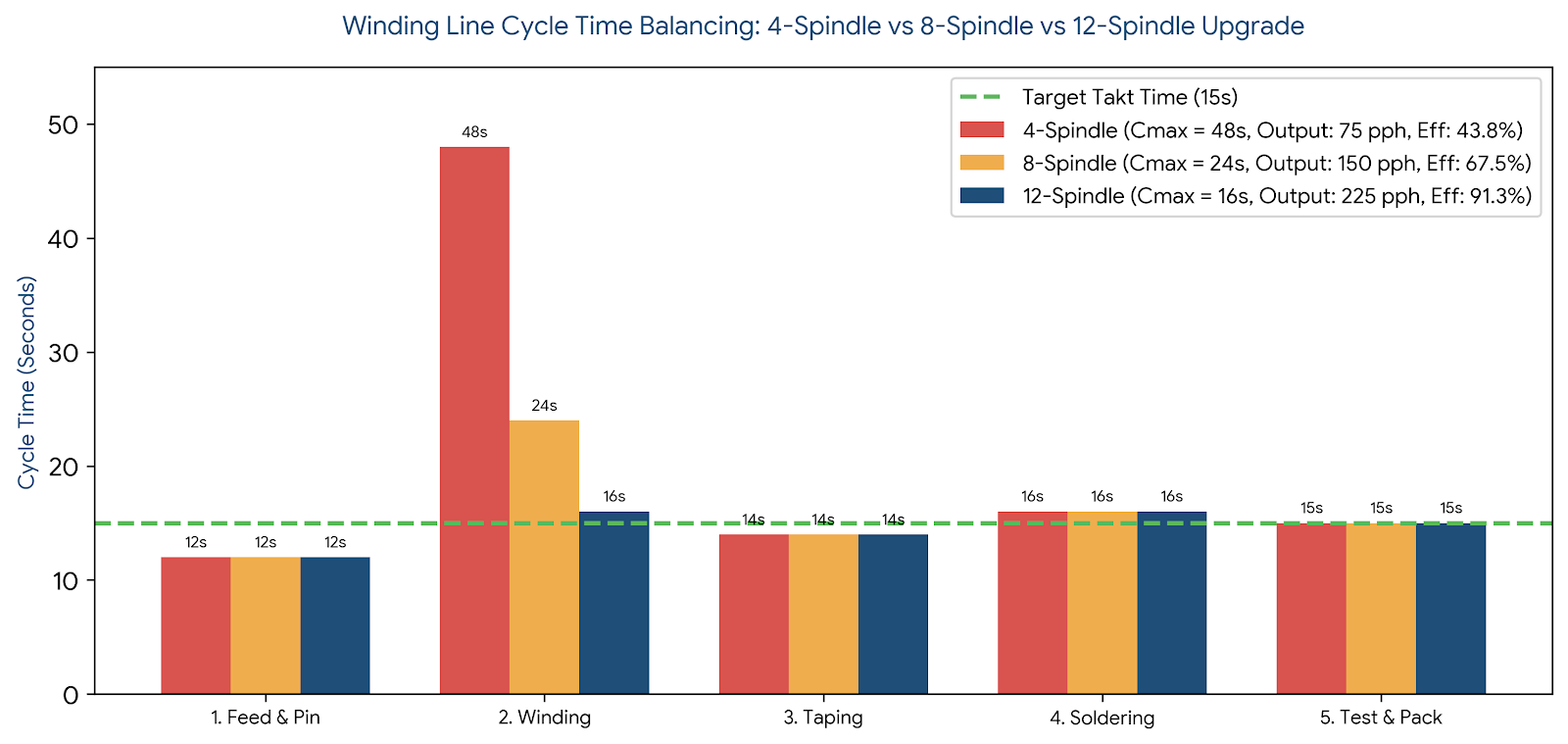
Figure: Cycle Time Distribution and Bottleneck Reduction Across 4-Spindle, 8-Spindle, and 12-Spindle Configurations vs Target Takt Time.
• Target Takt Time: 15s
• Station Cycle Times:
-
1. Feed & Pin : 12s
2. Winding : 48s (4-Spindle) / 24s (8-Spindle) / 16s (12-Spindle)
3. Taping : 14s
4. Soldering : 16s
5. Test & Pack : 15s
| Configuration | Max Cycle Time (C_max) | Line Efficiency (η) | Production Output | Balance Status |
|---|---|---|---|---|
| 4-Spindle | 48s (Station 2) | 43.8% | 75 pph | Severe Winding Bottleneck |
| 8-Spindle | 24s (Station 2) | 67.5% | 150 pph | Moderate Winding Bottleneck |
| 12-Spindle | 16s (Station 2 & 4) | 91.3% | 225 pph | Winding station and soldering station - near synchronization and maximized capacity |
🧮 Mathematical Formulas & Calculations
1. Line Efficiency Formula
Line Efficiency (η) = [ Sum of All Station Cycle Times / (Total Number of Stations × Maximum Cycle Time) ] × 100%
- Sum of Station Cycle Times: T_1 + T_2 + T_3 + T_4 + T_5 = 12s + T_winding + 14s + 16s + 15s
- Total Stations (N): 5 stations
- Maximum Cycle Time (C_max): The cycle time of the slowest bottleneck station.
2. Step-by-Step Calculation for Each Case
● Case 1: 4-Spindle Configuration
- Sum of Cycle Times = 12s + 48s + 14s + 16s + 15s = 105s
- Max Cycle Time (C_max) = 48s (Winding Station)
- Line Efficiency (η) = 105 / (5 × 48) = 105 / 240 = 43.8%
- Hourly Output = 3,600s / 48s = 75 pph (parts per hour)
● Case 2: 8-Spindle Configuration
- Sum of Cycle Times = 12s + 24s + 14s + 16s + 15s = 81s
- Max Cycle Time (C_max)x = 24s (Winding Station)
- Line Efficiency (η) = 81 / (5 × 24) = 81 / 120 = 67.5%
- Hourly Output = 3,600s / 24s = 150 pph
● Case 3: 12-Spindle
- Sum of Cycle Times = 12s + 16s + 14s + 16s + 15s = 73s
- Max Cycle Time (C_max) = 16s (Winding & Soldering Stations)
- Line Efficiency (η) = 73 / (5 × 16) = 73 / 80 = 91.3%
- Hourly Output = 3,600s / 16s = 225 pph
📊 Comparison of Common Engineering Strategies for Balancing Winding Production Lines
| Balancing Strategy | Technical Principle | Best Suited For | CAPEX / Complexity |
|---|---|---|---|
| Multi-spindle upgrades (e.g., from 4 spindles to 12 spindles) | Enhancing the high-density multi-spindle processing capacity of a single machine (e.g., expanding from 4 spindles to 12 spindles) | High-volume automated production lines for bobbins and coils | Highest return on investment; achieving near 100% line balancing without increasing the number of machines |
| Parallelization at bottleneck stations | Splitting or configuring multiple parallel winding module groups for parallel processing on a single production line | Extremely long winding time for a single coil (>60 seconds) or large stator products | Higher capital expenditure for equipment, and requires the configuration of a parallel transfer mechanism |
| De-Coupling | Moving time-consuming secondary processes (such as manual pin insertion, special coating) to offline independent processing | High-Mix Low-Volume production lines | Low capital expenditure, but requires maintaining inter-station work-in-process (WIP) buffer inventory |
| Dynamic tension and speed ratio optimization (RPM) Profiling | Dynamically optimizes acceleration/deceleration curves and wire speed ratios for different wire layers | For fine wires or multi-layer precision coil winding | Zero hardware cost, entirely driven and optimized by software and controllers |
How DETZO Helps Manufacturers Achieve Line Balance
- ● Upstream Feasibility & Simulation Analysis Before machine building begins, DETZO evaluates wire specs, bobbin geometries, and station cycle times through discrete event process simulations to prevent bottlenecks on paper first.
- ● Custom High-Density Mechanical Design Engineering multi-spindle motion platforms tailored specifically to match exact customer volume demands and factory layout constraints.
- ● Full-Line FAT with Real Cycle-Time Verification Simulating full mass-production speed in DETZO's plant prior to delivery to ensure target takt times and yield rates are fully met before on-site deployment.
a Taiwan-based manufacturer of coil winding machines and turnkey winding production-line solutions for EV motors, transformers, solenoid valves, and relay coils.